
Haddaway - What is Love
The Most Important Question Ever Asked on a Dancefloor

Listen.
LISTEN.
There is a song. It exists. It has existed since 1993. It was made in a basement studio in a small German town near Cologne by a Trinidadian man who did not even want to be a singer, who agreed to sing it essentially as a favor, who, when told to sing it like Joe Cocker, said — and I need you to sit with this — “I love Joe Cocker, but I’m no Joe Cocker.” And then he went and did something COMPLETELY different, something entirely his own, and what came out the other end was four minutes and change of pure, distilled, cosmically-ordained Eurodance perfection that somehow — SOMEHOW — conquered the entire planet Earth. Genghis Khan can eat a bowl of shit.
That song is What Is Love by Haddaway. And it should not exist. It should not have worked. And the fact that it did, and that it keeps working, and that it will almost certainly still be working at whatever future point humans have uploaded their consciousnesses into server farms and AI data facilities, and are slow-dancing in the digital void — that is the miracle we are here to discuss today.
Let’s set the scene, because the scene matters enormously.
The year is 1993. Kurt Cobain has already broken your older sister’s brain. Tupac is mid-ascent. Dr. Dre’s The Chronic dropped the previous December and is actively rewiring the DNA of popular music. Biggie’s Born to Die is 19 months away, which may as well be a century, and the 36 Chambers: Enter the Wu is nearly upon us. The entire cultural conversation in America is happening somewhere between a flannel shirt and a sample-chopped drum loop. Grunge is eating everything. Hip-hop is eating everything. These two genres are basically the twin black holes at the center of the musical galaxy, and anything that isn’t one of them is getting pulled apart by gravity and scattered into nothingness.
Into this environment, Haddaway walks up and goes: “What is love? Baby, don’t hurt me. Don’t hurt me. No more.”
AND THE WHOLE WORLD GOES ABSOLUTELY NUCLEAR FOR IT.
Number one in THIRTEEN countries. Thirteen. Not one. Not two. Thirteen sovereign nations looked at this song and said “yes, this is the one, this is what we want, give us more of this forever.” It hit number two in Germany, Sweden, and the UK. It cracked the American top twenty. It was everywhere. It was inescapable. It was, by any metric you want to use, a banger of the highest geological order — like, this was not a regular banger, this was a banger that had been compressed under millions of years of pressure and heat until it became a diamond banger, the Banger of the Earth’s Mantle.
The CONSTRUCTION of it is almost aggressively unreasonable. That synth line — you know the one, the one that sounds like someone taught a keyboard to feel longing — hits you before anything else, and it does something to a human brain that science has not yet fully explained. It bypasses the prefrontal cortex entirely. It goes straight to whatever part of you that used to believe anything was possible on a Friday night. The drums kick in and suddenly you have no choice. Your neck is moving. Your shoulders are involved. You are, against your will and better judgment, doing that thing where you bob your head and the bob becomes increasingly aggressive until you are a full, functioning member of the dance floor and you don’t even remember agreeing to this.
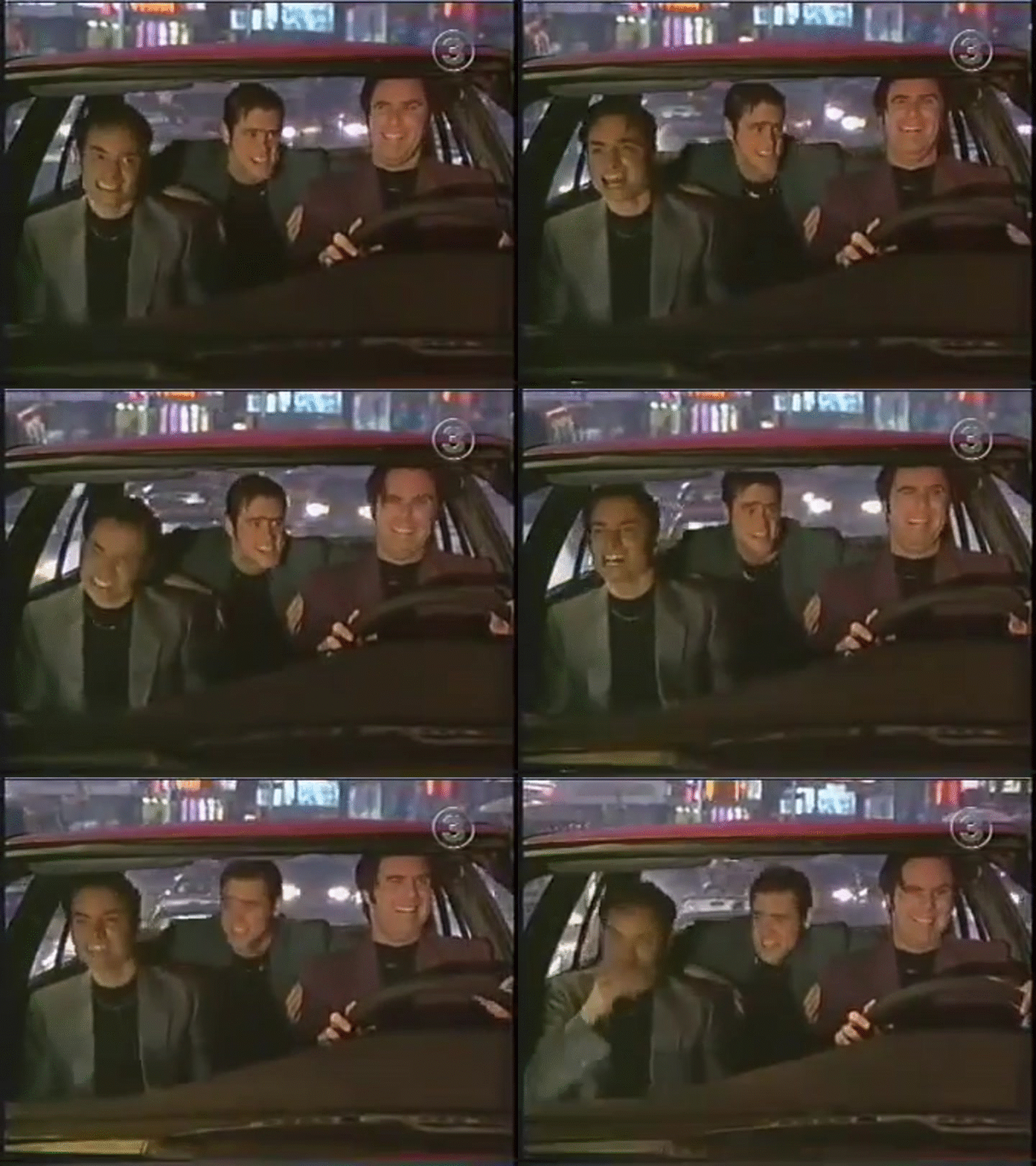
And then Haddaway’s voice comes in.
Haddaway’s voice on this song is doing something that I genuinely believe should be studied in music conservatories. He is singing a lyric that is, on its surface, pretty straightforward — a man is in pain, a man has questions about love, a man is asking that the person he loves stop causing him emotional damage — but the way he delivers it transforms the whole thing into something that feels ANCIENT. All the Gods are in on this…
He’s not just asking about his own love life; he’s asking on behalf of every human who has ever loved anything, ever, going all the way back to the first cave person who felt their heart do a weird thing when they looked at another cave person. The question is cosmic. The question is real. “What is love?” is genuinely one of the most important questions anyone has ever asked, and Haddaway asked it over a Eurodance beat, and somehow that made it MORE profound, not less.
Now. The irony era. We, by which I mean I, have to talk about it.
At some point in the late ‘90s, after Saturday Night Live put those two idiots in a club doing the head-bob thing (and listen, I love the bit, I love the bit, but let’s be honest about what it did), the song became a punchline. It became the thing you played at parties when you wanted everyone to laugh. It became IRONIC. And that’s fine, that happened, we can’t undo it. But here’s what’s interesting: the song survived the irony era completely intact. The song didn’t care. The song looked ironic appreciation dead in the face and said “okay, you think I’m funny, but you’re still playing me, and your body is still responding the same way it always did, and we both know what’s really happening here.”
That is RESILIENCE. That is a song with genuine structural integrity. Your grandfather could only dream of such aspirations.
Because the thing about ironic appreciation is that it’s actually just a coping mechanism for people who are scared to feel things unironically. The head-bob isn’t a joke. The head-bob is a confession. Every time someone puts on “What Is Love” to be funny, they are accidentally revealing that the song still has them. It got them in 1993, it got them in 1998 during the Will Ferrell SNL years, and it has them right now, in 2026, in whatever chair you are sitting in.
And eventually — this is the arc, this is the beautiful and completely insane arc — the irony collapses under its own weight and people just start loving it for real again. The song completes the full cycle. Unironic banger to ironic punchline to unironic gem. That third phase is rarer than people realize. Most songs that become ironic punchlines stay there. They become museum pieces. What Is Love became something else: a song that everyone in any room, at any gathering, of any age demographic, can hear the opening synth notes of and immediately feel something true and involuntary and good.
Here’s my final point, and it’s the most important one.
Haddaway didn’t even want to be there. He was doing a friend a favor. He wanted to be a producer. He told the people who wanted him to be Joe Cocker that he was not Joe Cocker. He went to a basement and made something that nobody wanted — every radio station, every record label, every single gatekeeper turned it away — until one new radio station in Cologne used it as a jingle, and then a thousand DJs heard it, and then the whole world heard it, and then the world didn’t stop hearing it for the next thirty-plus years.
That is not a music career. That is a VISITATION. Haddaway was visited by a song. He delivered the song to Earth because the song needed to exist here. The song had business to conduct. Questions to ask.
What is love?
You already know the answer. Your shoulders already know the answer.
Don’t play dumb.
I shoulda known.
Damn. You killed this. I love it. Now I *HAVE* to listen- and want to.