
Two Rooms, Two Sams
What Sam Cooke’s Live Albums Tell Us About Survival in America

For Don and Sheena
There are two Sam Cooke albums recorded live in 1963, separated by just a few months, but really separated by the entire history of race in America. One of them you’ve probably heard. The other one almost didn’t get released at all.
Sam Cooke at the Copa came out in 1964. Live at the Harlem Square Club, 1963 didn’t see the light of day until 1985, twenty-one years after Sam died and fourteen years after RCA finally decided America might be ready for it. If you want to understand code-switching — that exhausting, necessary performance of self that every marginalized person in this country has to master just to survive — you could read a dozen sociology papers or you could just listen to these two albums back to back and feel it in your bones.


Dave Chappelle has this bit about how every Black American is bilingual. “We speak street vernacular,” he says, “and we speak job interview.” It’s funny because it’s true, and it’s devastating because it’s true. Live at the Copa is the job interview. Live at the Harlem Square Club is what happens when you get home and take off the tie.
The Copacabana was the most famous nightclub in America in 1963. It was where Frank Sinatra performed, where Dean Martin held court, where white people in evening wear paid premium prices to feel sophisticated. Sam Cooke playing the Copa was a big deal. It meant he’d arrived. It meant he was respectable. It meant white America had decided he was safe enough to let through the door.
Listen to Live at the Copa and you can hear Sam working. He’s performing a very specific version of himself — smooth, unthreatening, almost apologetic in his gratitude for being there. He does Bill Bailey, a vaudeville number that was old when his parents were young. He does When I Fall in Love, a standard so safe it might as well be wrapped in bubble wrap. He even does If I Had a Hammer, which is nominally a protest song, except the way Sam performs it at the Copa, it sounds like he’s singing about actual carpentry. The arrangements are lush, orchestral, designed to make white audiences feel like they’re experiencing “class.” Sam’s between-song patter is cheerful and deferential. “Thank you so very much,” he says, over and over. “You’re a wonderful audience.”
It’s still a good album, if passingly inauthentic. Sam’s voice is one of the natural wonders of the 20th Century, and even when he’s code-switching so hard you can practically hear his jaw aching, he sounds incredible. But there’s something you can feel missing, some essential Sam-ness that’s been filed down to fit through the Copa’s door.
Now put on Live at the Harlem Square Club and brace for the fucking shock.
The Harlem Square Club was a Black nightclub in Miami’s Overtown neighborhood. This was not where white people went to feel sophisticated. This was where Black people went to dance and sweat and hear music that actually moved them. And the difference between the two albums isn’t just in the setlist or the arrangements. It’s in the fundamental nature of what’s happening. For the love of all things holy, the liquor in the Harlem Square Club was served from behind chain-link fence guarded by men with shotguns.
From the first seconds of Live at the Harlem Square Club, you can hear that Sam isn’t performing respectability. He’s not making himself smaller. He’s not translating himself into a language designed to make white people comfortable. He’s home.
The album opens with Feel It, and Sam’s not singing; he’s testifying. The band isn’t an orchestra, it’s a freight train. The guitar tears through the mix like it’s angry about something. The horns don’t swell elegantly; they punch (That’s legendary bandleader and sax player King Curtis… you know what… we’re gonna take a whole aside here and discuss King, because he deserves it).
The Black community doesn’t give you a name unless they fucking mean it and it matters. He was born Curtis Montgomery in Fort Worth, Texas. He was classmates and studied with and performed on the horn with Ornette Coleman (who is a case study in and of himself). He took the name Curtis Ousley after his adoptive family and kept it his entire life. He disregarded scholarships to go play with Lionel Hampton and ended up playing Lionel and… Wynton Kelly, Nat Adderly, Buddy Holly, Waylon Jennings, Aretha (there’s exactly one Aretha, so I don’t feel compelled to offer her last name), the Coasters (That’s him on Yakety Yak and Charlie Brown), some motherfucker from Seattle named Hendrix, and a former Beatle who answered to John. That’s him and his band backing up Sam on the album. He. Was. The. Fucking. King.
And Sam? Sam is letting loose in a way he never does at the Copa. His voice gets ragged. He screams. He grunts. He moans. When he sings Bring It On Home to Me, it’s not a pretty ballad; it’s a raw, desperate plea that sounds like it’s being ripped out of his chest.
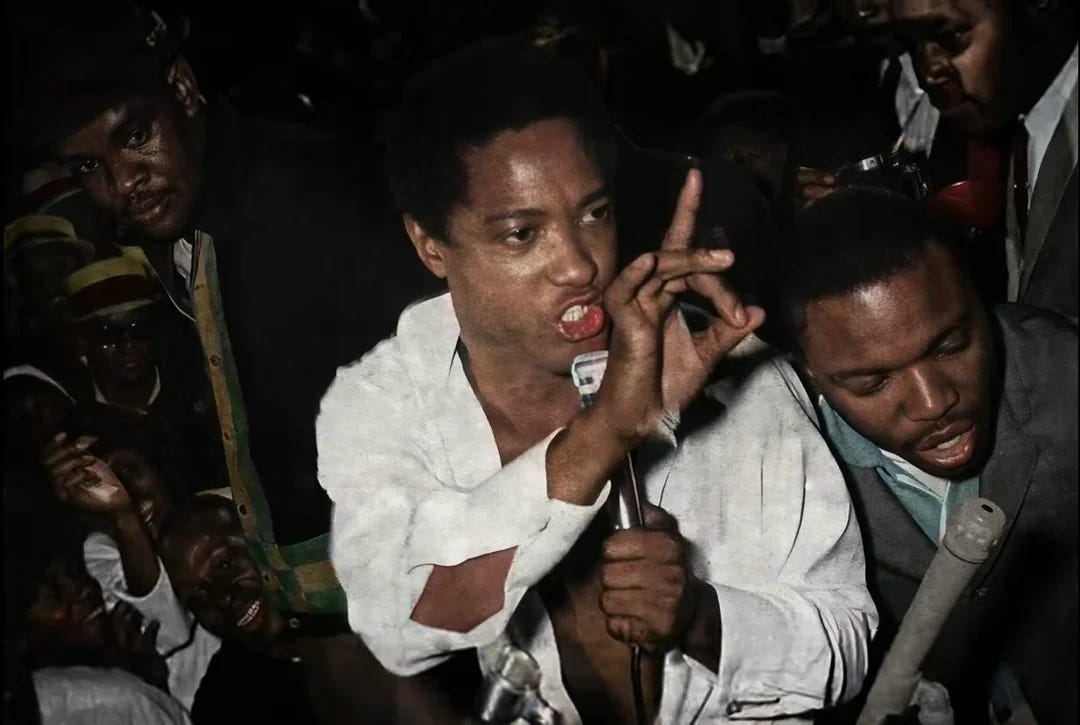
The audience at Harlem Square is responding like people at a religious service, and in a way, that’s exactly what this is. “Sing it, Sam!” they shout. “Tell it!” They’re not politely applauding between numbers. They’re inside the music with him, and he’s inside it with them, and what’s happening isn’t a performance, it’s communion.
This is street vernacular. This is the voice you use when you’re not being watched, when you don’t have to make yourself acceptable, when you can just be.
The tragedy is that Sam Cooke had to make both versions of himself to survive. The Copa show wasn’t fake. That was Sam too, just a different translation. Code-switching isn’t lying. It’s survival. It’s the price of admission to spaces that were designed to keep you out.
RCA knew exactly what they were doing when they shelved the Harlem Square album for two decades. They heard that raw, unpolished, undeniably Black performance and decided white America wasn’t ready for it. In 1963, white audiences wanted the Sam Cooke who sang You Send Me and smiled graciously. They didn’t want the Sam Cooke who could barely contain the gospel fire in his voice, who made music that was so Black it couldn’t be packaged and sold to white suburbia without losing everything that made it powerful.
The most important question you can ask about any piece of art is “what is this really about?” These albums are ostensibly about Sam Cooke’s vocal prowess, but what they’re really about is the cost of being Black in America. They’re about the mask and the face underneath. They’re about the deal Sam had to make - be respectable enough for white audiences or be authentic enough for Black ones, but understand you’ll probably never get to be both at the same time in the same room.
There’s a moment on Live at the Harlem Square Club where Sam performs Somebody Have Mercy. By this point, he’s been going full throttle for forty minutes, his voice shredded in the best possible way. It’s 20 to 2 in the morning. He’s screaming the chorus, the band locked into a groove that could power a small city, the audience losing their minds. And I listen to this and think: this is what he could have been doing the whole time. This is what America could have had if it hadn’t demanded he shrink himself to fit through their door.
Sam Cooke was murdered in 1964, less than a year after both performances. He was 33. We’ll never know what music he might have made if he’d lived, but we know this: he spent his career navigating between these two rooms, these two audiences, these two versions of himself. He never got to choose just one.
The fact that Live at the Harlem Square Club was buried for twenty years tells you everything you need to know about which version of Blackness was acceptable in America and which version had to be hidden away. The job interview Sam was marketable. The street vernacular Sam was too dangerous, too real, too unapologetically himself. It’s also perfect, holy, and a revelation.
In 2026, we like to think we’ve evolved past this. I would love to think we’ve evolved past this. But every Black person reading this just laughed bitterly, because they’re still doing it. Still speaking two languages. Still performing respectability in white spaces and saving their full selves for rooms where it’s safe.
That’s why these albums matter. Not just because they showcase one of the greatest voices in American music, but because they document the split-screen reality of Black life in America. They’re evidence of the toll that dual consciousness takes. They’re a record of what gets lost in translation.
If you’ve never listened to Live at the Harlem Square Club, do it now. Then listen to Live at the Copa right after. Pay attention to what changes and what stays the same. Notice the brightness in Sam’s voice at Harlem Square, the way he seems to physically expand into the space. Notice the careful control at the Copa, the way he measures every gesture to avoid being too much.
And understand that this wasn’t a choice Sam got to make freely. This was the deal America offered him: you can be successful, but only if you perform the right version of yourself for the right audience. You can have the Copa, but you have to leave Sam at Harlem Square behind.
He did both, brilliantly, because he had to. But we should never forget what it cost him, and what it still costs every person in this country who has to master the art of being bilingual in their own skin.
Two rooms. Two audiences. Two Sams.
Same brilliant, doomed, irreplaceable man, just trying to be heard.
Growing up listening to these albums along with BB King Live at the Regal, BB King and Bobby "Blue" Bland Together for the First Time...Live, and James Brown Live at the Apollo created my love for live music. Well, that and seeing BB King live every year from ages 6 to 16 and seeing Prince open for Rick James. Thus, as you indicate, the church, the cafe, and the juke joint were some of the few places where black folks could be whoever they were in their fullness, which is why the live performances were so powerful. As such, these two albums show us that, originally, studio records were a faint attempt to capture the magic of live performances and that the most skilled artists always take the audience beyond the recording to a new and heightened experience with the live performance. As Miles Davis famously said to Herbie Hancock, "Don't play it the same effin' way every effin' night!" because the circumstances of the night and venue should dictate the performance of the work.
You make it hard to comment on these posts. Why? Because you say everything that needs to be said. Beautifully.