
The Faces - Ooh La La
Knowledge You Can’t Download

There’s a three-minute thirty-two-second lesson in epistemology hiding inside what most people file under boozy Faces-era Rod Stewart — the kind of song that soundtracks pub closings and wedding receptions without anyone really attending to the words. Ooh La La is usually heard rather than listened to. That’s a loss, because the song is doing something philosophically serious underneath the piano and the ramshackle charm: it’s mapping the hard limits of knowledge transmission, the precise boundary where information becomes irreducible to instruction.
Here’s the setup. A grandfather tries to warn his grandson about the particular bewilderments of romantic life. The grandfather is not a naive man. He’s been through it. He has what we would call, in information systems terms, a rich experiential dataset. He knows things. And he knows something more unsettling than the things he knows: he knows that knowing them will not help.
Poor young grandson, there’s nothing I can say
You’ll have to learn, just like me
And that’s the hardest way.
That’s the song’s emotional and intellectual payload, delivered near the end, after all the warnings have been issued and absorbed and futilely deployed. The grandfather has attempted to transfer his entire corpus of romantic wisdom. None of it will make the crossing. The grandson will nod, perhaps with genuine warmth, and then go do exactly what grandfathers have always watched their grandchildren do.
This isn’t a failure of communication. It’s a structural feature of certain categories of knowledge.
The philosopher (and polymath) Michael Polanyi spent a substantial part of his career trying to articulate what he called tacit knowledge — the kind of knowing that lives in the body, in repeated experience, in the felt texture of having been through something. His famous example was bicycle riding. You cannot learn to ride a bicycle by reading an accurate description of how to ride a bicycle. The description might be flawless, the physics perfectly rendered, and it will be worthless to you when you wobble and correct and wobble again. The knowledge is in the wobbling and correcting. It has to be metabolized, not received.
Romantic experience is tacit knowledge of almost pure type. The grandfather in Ooh La La understands this. He tells his grandson that love is blind, that the backstage dressing rooms are grey while the performance out front is dazzling. He’s describing the gap between the thing as it presents and the thing as it is — genuinely useful intelligence. And it changes nothing. Because “love is blind” as a proposition you’ve heard described and “love is blind” as a state currently running on your nervous system are not the same thing and do not live in the same part of the brain.
We have built enormous institutions around the premise that propositional knowledge transfers across persons through language. Schools operate on this premise. Most of what gets classified as wisdom literature operates on it. The premise holds for a wide range of content — mathematics, history, the operating manual for a dishwasher. But there is a category of understanding where it collapses entirely, and that category is larger and more consequential than we typically acknowledge.
I’ve thought about this since my daughter was born. The things I most want to spare her from are precisely the things I cannot spare her from by naming them. I can describe the specific gravity of certain kinds of loss with whatever precision I can muster. I can give her the grandfather’s speech, verbatim and annotated. She will listen with love and with what I suspect is a fraction of her actual processing capacity. And then she will go learn the hardest way. Not because she isn’t paying attention. Because that’s the topology of this particular knowledge — it has no read/write access from the outside.
The grandfather knows this. That’s what makes the lyric devastating rather than merely melancholy. If he thought the warning might work, there would be hope radiating off it. Instead, there’s something more structurally interesting: an act of connection performed in full awareness of its practical futility. He speaks because the grandson deserves to be spoken to. Because the transmission attempt is itself a form of relationship, even when the data doesn’t survive the handoff.
This is where the song complicates its own earlier framing, which is, to be clear, remarkably ungenerous toward women. The first two verses describe romantic partners as trappers, heart-thieves, performers who reduce their lovers back to boyhood. It’s vulnerability rendered in the idiom of grievance — women as agents of a specific diminishment. But by the third verse, something shifts. The grandson is left “twinkling with the stars,” which is strange and beautiful phrasing that refuses the architecture of complaint. And the grandfather’s final words abandon warning entirely. He has nothing that will stick. He has only the word learn, which implies not victimhood but accumulation — the gradual acquisition of exactly the kind of knowledge that cannot arrive any other way.
The song positions the chorus as lament — I wish I knew then what I know now — and it is a lament. But there’s something else embedded in it, if you let it sit. The things you learn the hardest way carry a weight that instruction cannot manufacture. They’re fused to the moments of their acquisition. They’re yours in a way that downloaded information simply isn’t. There’s a reason we don’t fully trust the judgment of someone who has only read about a thing. The experiential residue is what makes the knowing reliable. The cost is the credential, and it often comes with scars.
This creates a genuine problem for anyone who cares about reducing unnecessary suffering. If certain categories of knowledge are genuinely non-transferable, then the best we can offer each other is presence before and afterward — I will be here while you go through this, and here again when you come out the other side. The grandfather’s speech isn’t useless because it fails to prevent pain. It works by demonstrating, structurally, that the grandson is not alone in a lineage of confusion — that people have been through this and remained standing and retained their capacity to love the next generation enough to try, again, the impossible warning. That’s not a small thing. It might be everything available.
Ooh La La was written by Ronnie Lane and Ronnie Wood for the Faces’ final album in 1973, and it’s Wood — not the band’s nominal star, Rod Stewart — singing lead. Stewart reportedly declined to record the vocal, a decision he would later describe as one of his deepest professional regrets. Sit with that for a moment. The song whose entire emotional argument is I wish I’d known then what I know now was passed over by the one person who would subsequently spend years wishing he hadn’t passed it over. The song ate its own theme before it even left the studio. Stewart got to experience the lesson the song was teaching, through the precise mechanism the song was describing, about the song itself.
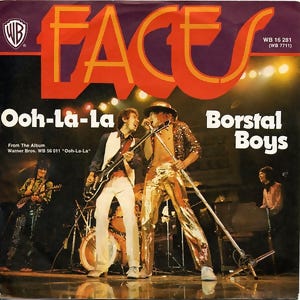
Wood’s vocal suits the material in ways Stewart’s wouldn’t have. There’s no performance in it, no the-star-has-arrived quality. It’s intimate and slightly hesitant, which is exactly right for a story about the limits of what one person can convey to another. Lane’s bass and Ian McLagan’s unlabored piano give the track a quality of something almost overheard — a conversation not staged for an audience.
I still catch myself wanting to argue with the grandfather’s conclusion, wanting to insist that some warnings do land, that some younger selves do update on the testimony of older ones. And some do, on some matters. But the chorus keeps returning, and it doesn’t carve out exceptions. It wishes, with evident feeling and without bitterness, that there had been some other route through. There wasn’t. There isn’t.
Stewart knew it too, eventually.
You learn, just like me, and that’s the hardest way.
Ooh la la.