
The Cure - Just Like Heaven
On the Trick Robert Smith Did Not Know He Was Performing

Act One
The Pledge
Just Like Heaven is not a sad song. This matters more than you think, because The Cure wrote sad songs the way other bands wrote chord progressions — reflexively, structurally, as a kind of default setting. Robert Smith spent the better part of a decade making music that sounded like crying felt, and he was very good at it. So when Just Like Heaven arrived in 1987, cascading out of Kiss Me, Kiss Me, Kiss Me on a wave of chiming guitar and almost aggressive euphoria, the instinct for anyone paying attention was suspicion. This sounds too good. Something must be wrong.
Christopher Nolan, in The Prestige, has Michael Caine explain that every great magic trick has three parts. The first is called The Pledge. The magician shows you something ordinary. A man. A woman. A bird. Nothing special yet. He is setting up your expectations so he can dismantle them.
Here is the ordinary thing: a man on a cliff in the dark.
The song came from a night Smith spent at Beachy Head, the chalk headland in East Sussex that juts dramatically into the English Channel and has, for reasons both geological and cultural, become one of the most famous suicide sites in the world.
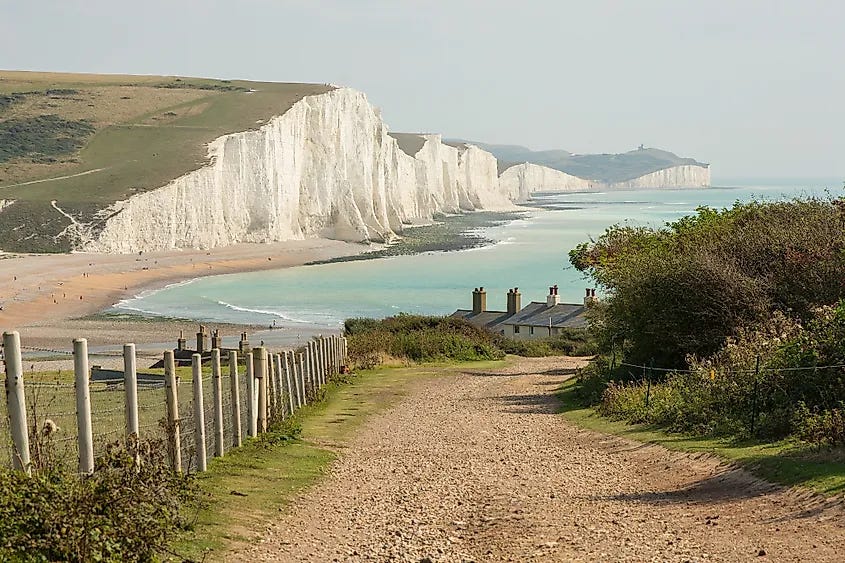
Smith was there with friends, they’d been drinking, and the fog came in so suddenly and so completely that he lost sight of everyone and couldn’t see his hand in front of his face. He sat down on the cliff’s edge in the dark and the fog until dawn, convinced that if he moved he would fall. His friends, by his own account, did not look for him. He heard voices in the fog. He thought about ghosts. He had what sounds like either a genuine mystical experience or a panic attack, and possibly both simultaneously, because those two things are less different than we’d like to admit.
Show you something ordinary. A man, afraid, alone, waiting for morning. Nothing about that sentence suggests the most purely joyful song of anyone’s career is coming. That’s the point.
Act Two
The Turn
The second act is called The Turn. The magician takes the ordinary thing and makes it do something extraordinary. This is the part where you’re not supposed to look too closely, because if you do, you might catch how it’s done, and catching how it’s done ruins it.
Smith went home and wrote the most purely joyful song of his career.
This is the part that Chuck Berry understood and that most rock criticism still hasn’t fully metabolized: the emotional content of a song and the biographical content of a song are almost never the same thing, and the gap between them is where the actual art lives.
Smith sat on a cliff in the dark, genuinely frightened, abandoned by his friends, listening to voices that may or may not have existed, and he transmuted that experience into something that sounds like falling in love in slow motion. The song isn’t about Beachy Head. The song isn’t even really about Mary Poole, his girlfriend and eventual wife, though she’s in it. The song is about the specific feeling of a moment so good it makes you dizzy — the hyperventilation of happiness, the way real joy has a physical quality that’s almost indistinguishable from vertigo.
Listen to how it opens. That guitar line — Porl Thompson’s contribution, clean and impossibly bright — doesn’t build toward anything. It arrives fully formed, like a memory you didn’t know you had. Then the lyric: Show me, show me, show me how you do that trick / The one that makes me scream. People mishear this line constantly. They think it’s coy or suggestive, and it might be, but the line that follows it — the one that makes me laugh — reframes the whole thing as something stranger and more honest. Smith isn’t describing seduction. He’s describing the experience of being with someone who has figured out how to make you feel something you can’t name. The trick isn’t a trick. It’s just her.
The second verse moves to the cliff, though you’d never know it if Smith hadn’t told you. Spinning on that dizzy edge is literal — he’s standing near the drop at Beachy Head — but it functions as pure romantic metaphor, the kind of line that works in both registers simultaneously without straining in either direction. Most songwriters who try to write love songs about dangerous places end up with something that feels either melodramatic or ironic. Smith does neither. He’s sincere about both things at once, and the song holds them in suspension, not tension.
Then there’s the question the song actually asks, buried in the second verse and easy to miss because the melody carries it so lightly: Why won’t you ever know that I’m in love with you? This is a fundamentally different sentiment than the opening verse, and the shift is almost imperceptible. The song begins as mutual. The girl asks for the trick, she promises to run away with him, but by the second verse the perspective has tipped, and suddenly the person speaking isn’t sure the feeling is returned, or known, or real. Why are you so far away? she asks. Or he does. The pronouns have gotten slippery in a way that feels intentional.
The chorus resolves nothing and that’s entirely the point. You, soft and only / You, lost and lonely / You, strange as angels. These are not descriptions. They’re feelings rendered as attributes, the way you’d characterize someone in a dream where their qualities are vivid but their face keeps shifting. You’re just like a dream — and the word “just” is doing some of the heaviest lifting in history there, because it means both exactly and merely, and the song lives in that liminal space.
Smith told an interviewer in 1987 that Just Like Heaven was probably the easiest song he’d ever written to understand. He was wrong, or he was talking about something other than what most people mean by understanding. The lyrics are simple. The emotion is not. The song is about joy, but it’s a specific kind of joy, the kind that arrives with a slight edge of panic (the rarest kind), that feels too good to be sustainable, that makes you want to sit very still so you don’t break it.
This is The Turn. The man is still on the cliff. He has not moved. And yet somehow everything is different.
Act Three
The Prestige
The third act is called The Prestige. This is the part that matters, and the part that’s hardest to explain. The magician brings the ordinary thing back. The bird returns. The woman steps out of the box. The ordinary thing was always the point, and the extraordinary middle was just the mechanism. But something is different now. It isn’t the same bird it was. It can’t be. You’ve seen what it can do.
Smith told Blender in 2003 that the idea behind the song was that one night like that was worth a thousand hours of drudgery. He meant it as a romantic statement, and it is one. But it also functions as a philosophy of experience — the argument that transcendence is real even when it’s brief, that the fog and the cliff and the voices in the dark are the price of admission for getting to feel something that completely. The song doesn’t romanticize suffering. It argues that suffering is sometimes the context in which the best moments happen, and that the best moments are worth remembering clearly.
That’s why Just Like Heaven doesn’t feel like a Cure song, even though it’s one of their finest. It isn’t sad. It isn’t goth. It doesn’t reach for the darkness the way the rest of Smith’s catalog instinctively does. It reaches for the thing the darkness was keeping him from seeing, and it finds it, and for three minutes and thirty-two seconds it holds it up and says: look at this. Look at how good this is.
It is, in other words, exactly the feeling of standing on a beautiful cliff in the dark, afraid to move, waiting for morning. The man is back. The cliff is back. The fog was real and the voices were probably real and his friends definitely did not look for him, and none of that has changed. He is still ordinary. The situation is still ordinary. Except now you’ve heard the song, and so is it? Is he?
Every great trick, Caine says, is asking you to look for the secret. But you won’t find it, because you’re not really looking. You don’t really want to know. You want to be fooled.
The trick, it turns out, is the song itself.
I love the Cure, and this is my favorite song of theirs - and for a time, I would have said this is my favorite song of all time. It's definitely top 5! Beautiful essay - I never knew the story about Beachy Head.
It’s my favorite of their’s and means something to me in the most cliche of ways.
After 45,000 listens however, I’m always curious how one would spell the word he sings after “Twisting in the” ______.
I know WHAT the word is, I just always wonder what the spelling of it would be as pronounced.