
OutKast - Ms. Jackson
Forever Ever

Every apology song is secretly about jurisdiction. Somebody did something, and now somebody gets to decide whether the apology counts, and this arrangement is rarely fair, because the person issuing the apology usually believes they are being graded on effort, while the person receiving it is grading on outcome. OutKast on Ms. Jackson understood this dynamic better than any song released that decade, which is remarkable, because that decade was heavy on money, cars, and surviving the Y2K apocalypse. None of that mattered nearly as much as the generational puzzle of what happens when two people make a baby and then stop making sense together.
André 3000 wrote his verse from inside a specific wreckage, the end of his relationship with Erykah Badu, and has said as much in interviews. This frames the song as an attempt to imagine the perspective of a mother watching her daughter get left holding a child and a broken promise. This is the detail that separates Ms. Jackson from every other song about baby mama drama that absolutely fucking saturated hip-hop radio and television in that era, because most of those songs treated the mother-in-law figure as a punchline, a nagging obstacle standing between the man and his freedom. André did something far more strange: he tried to occupy her position, or at least gesture toward it, which is a move so wildly uncharacteristic of mainstream rap in 2000 that it would be like discovering a Sports Illustrated swimsuit issue that also included a thoughtful essay about maternal grief penned by Joan Didion. You absolutely do not expect empathy to arrive in that particular room, and yet, there it is, resplendent in a silk bath robe holding a Mai Tai.
Big Boi’s verse operates in a completely different emotional register, and this remains one of the most underrated structural elements of the song. It allows two men to process the same basic situation - an unplanned pregnancy and a hostile ex-mother-in-law - but through entirely different temperaments. Big Boi is aggrieved and practical, paying medical bills and private school tuition while somebody’s mother organizes cookouts to which he was never going to be invited, and his frustration boils out of him like a man who has read the terms of a contract he never agreed to autograph. André is diffuse and philosophical, wishing he could become a magician and abracadabra away the sadness, which illustrates the staggering dichotomy the man possesses. It’s either the most beautiful admission of helplessness in hip-hop since Mind Playing Tricks on Me or the most 2000-era André ever committed to tape. Stankonia was the album where OutKast fully became the group that could contain multitudes without anyone accusing them of false advertising, and Ms. Jackson is the clearest evidence of that range packed into a single track. I have decided both are true, because they are.
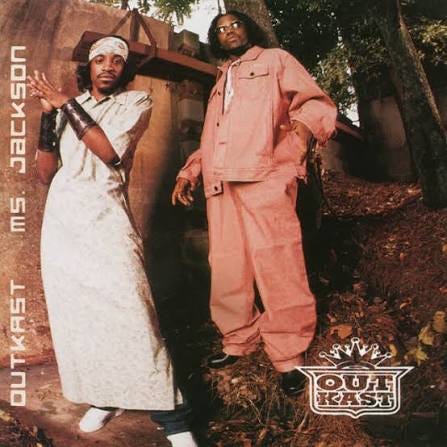
What makes the song work as pop music, as opposed to merely working as a well-observed character study, is the chorus, which does something almost embarrassingly simple. It just says sorry, four times, with escalating sincerity, over a beat built around a piano line that sounds like something ol’ Ludwig Van would have written if he had grown up on ‘90s Atlanta radio and not in Bonn. This is not a criticism. It is a truth that the most successful pop songs tend to smuggle complicated ideas inside deceptively uncomplicated hooks, the same way a Trojan horse smuggled Greek soldiers (timely pop culture reference for the fucking win). Ms. Jackson smuggles a genuinely thorny meditation on generational resentment and co-parenting inside a chorus so absurdly catchy that children were singing it in elementary school hallways without any idea what a custody war entails. That also tells you just how powerfully good songwriting can transcend its own subject matter.
The choice of the name Jackson deserves its own paragraph, because OutKast has said they picked it specifically for its ordinariness, wanting a name that felt universal rather than specific to any one person’s actual mother-in-law. This mirrors something that happens constantly in fiction, where a creator sands down a proper noun until it becomes a vessel rather than a portrait, allowing millions of listeners to project their own Ms. Jacksons onto the song. Everyone has known a version of this woman, whether she is a grandmother, an ex’s mother, or some composite assembled from every disapproving glance a boyfriend has received at a holiday dinner. The song becomes a Rorschach test wearing a Grammy-winning beat.
Erykah Badu eventually confirmed what most listeners had already assumed, admitting years later that the song was a sore subject for her personality, which makes sense given that exactly nobody particularly enjoys becoming the unnamed inspiration for a song about their own failed relationship on every radio station in the damned country. What is stranger, and more delightful, and more purely American than almost anything else in this entire story, is that her mother apparently loved being associated with the song enough to get a license plate that read MSJACKSON. This single detail could justify an entire separate essay about the difference between how a song’s subject experiences the song and how that subject’s parent experiences the song, because apparently there exists a version of being immortalized in a chart-topping hip-hop single that feels less like an invasion of privacy and more like winning a small, strange lottery.
Ms. Jackson managed to make an entire country feel implicated in a story about accountability without making anyone feel personally accused. Everybody sang the apology, and almost nobody stopped to ask who, exactly, they were apologizing to, or whether an apology sung roughly eight trillion times on the radio actually deserves to hear it. That ambiguity, more than the piano hook or the Grammy or the license plate, is probably why the song refuses to age the way so many of its contemporaries have.
There is also something to be said for how the song refuses easy villains, which places it in stranger company than its chart position would suggest. Ms. Jackson keeps moving the blame around like a shell game, letting Big Boi resent the mother while still loving the daughter, letting André resent the situation while still wanting to be present on the first day of school, and never quite settling on who deserves the apology being issued. The songs that endure tend to be the ones that ask a question rather than answer one, and Ms. Jackson asks several at once without resolving any of them, which might be the closest thing hip-hop has produced to a Chekhov play, if Chekhov had access to a Brothers Johnson sample and a chorus built for stadium singalongs.
Great storytelling is nuanced; this one sure is, as well as the commentary about it.
outstanding essay. the 2nd sentence here is a BANGER:
“What is stranger, and more delightful, and more purely American than almost anything else in this entire story, is that her mother apparently loved being associated with the song enough to get a license plate that read MSJACKSON. This single detail could justify an entire separate essay about the difference between how a song’s subject experiences the song and how that subject’s parent experiences the song, because apparently there exists a version of being immortalized in a chart-topping hip-hop single that feels less like an invasion of privacy and more like winning a small, strange lottery. “