

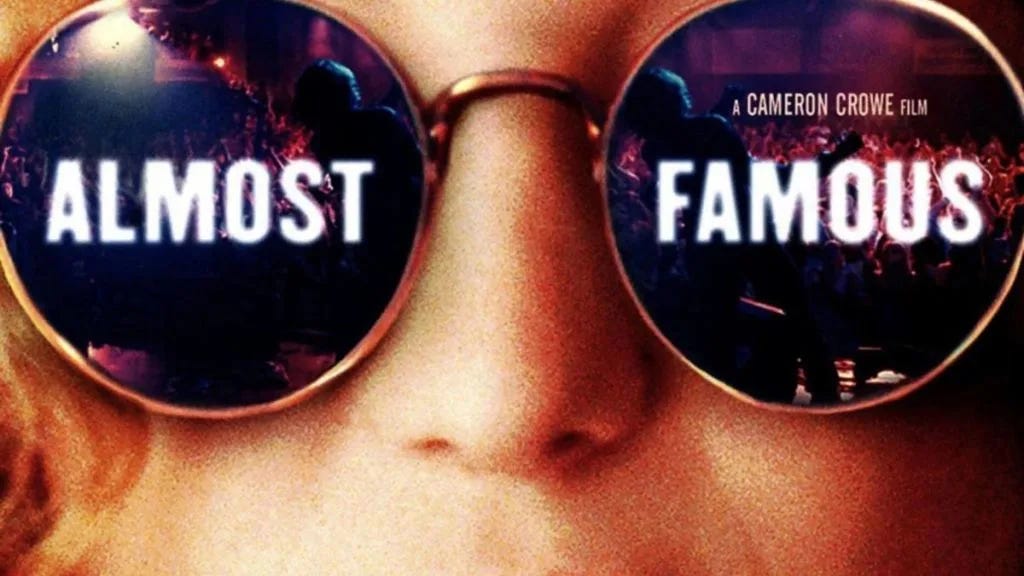
Here is what I believe, and I believe it the way I believe in Kind of Blue and the first three Stooges records and the moment in a Strokes show when everything goes wrong and then somehow, impossibly, goes exactly right: Cameron Crowe’s Almost Famous is a genuinely important American film, and the reason it doesn’t get treated as such is that it has too much feeling in it for people who have decided that feeling is embarrassing. We built an entire critical vocabulary deployed as a termination of discussion rather than a description, specifically to exclude the kind of movie where a bus full of people singing Tiny Dancer is presented without irony.
I am not embarrassed by feeling. Feeling is the whole point. If you have somehow gotten to the end of Almost Famous without your chest doing something complicated, then either you have never loved a piece of music more than was strictly rational, or you have loved one and then learned to be ashamed of it, which is worse, and is in fact the entire problem the film is diagnosing.
Almost Famous is a movie about the dangerous, ridiculous, holy business of loving something that cannot love you back. That is the first thing to say, and maybe the only thing that matters, because if you don’t start there, you wind up talking about nostalgia like it is a decorating style instead of a nervous condition. Cameron Crowe made a film in 2000 that pretends, at first glance, to be a warm bath of rock history and adolescent wonder, a valentine to an era — all Led Zeppelin and The Who and the last moment before corporate rock ate everything real and replaced it with a demographic and algorithmic delivery mechanism. That’s the bait. The deeper trick is that the movie understands music the way people understand religion when they are too young to have fully admitted they believe in anything at all: as an arrangement of longing, ritual, reverence, and embarrassment. It understands that the thing you worship is never just the thing itself. It is also your loneliness, your appetite, your fantasy of being seen, your private weather system, and your alibi for staying alive another day.
That is why the film’s best lines do not function like dialogue so much as they function like articles of faith. Lester Bangs says, “The only true currency in this bankrupt world is what you share with someone else when you’re uncool.”
That line is not a cute epigram. It is the movie’s operating system. It means that coolness, whatever else it is supposed to do, is often a machine for concealment. Cool people protect themselves. They posture. They ration access. They treat feeling like a liability. But uncoolness, in the sacred and humiliating sense, is what happens when somebody gives you something real before they have made sure it will be admired. Uncoolness is the exchange rate of sincerity. It is what you spend when you say the thing you meant, not the thing that will make you look desirable. And if that sounds sentimental, fine. Sentimentality is only a cheap word people use when they are afraid that tenderness might have structural value.
Almost Famous knows better than to let tenderness float untethered. It keeps dragging emotion back through the mud where it belongs. The movie’s great invention is that it makes adoration look both pure and compromised at the same time. Young William Miller does not just like music. He is wounded by it, seduced by it, educated by it, and then nearly ruined by the very dream of proximity it creates. He begins as the kind of kid who believes records contain more truth than adults do, which is often correct, and then discovers that the people nearest the music are not divinities but workers, hustlers, exiles, narcissists, and beautiful liars. That discovery should be a disappointment, but it is not quite. It is the price of admission. To love the music is to be exiled from innocence, and to be exiled from innocence is sometimes the only way to become a person.
That is why Penny Lane’s line hits like a flare in a dark room: “... and if you ever get lonely, just go to the record store and visit your friends.”
On the surface, it is a sweet thing to say. It is the sort of line that could be printed on a poster and sold in a dorm room to people who think their tastes make them more alive than everyone else. But in the movie it lands differently. It suggests that records are not objects at all. They are addresses. They are names in a directory of the interior life. You do not merely hear them; you return to them. You go where they are because they have made a place for you. That is a beautiful idea, and also a dangerous one, because it implies that music can substitute for the civic failure of ordinary life. If the world is too lonely, too blunt, too uninterested in you, then the record store becomes a substitute parish, a social commons for the emotionally overdrawn. But then the film asks the harder question: if music is your refuge, what happens when refuge becomes fantasy? What happens when the store closes, when the friends are only sleeves and grooves, when the consolation you have built for yourself starts to look like avoidance?
That tension is all through Almost Famous, which is why it is not enough to call it a coming-of-age movie. Coming-of-age suggests a clean passage from ignorance to knowledge, but this movie is messier and more humane than that. It is about arriving at knowledge and finding that knowledge is not a summit; it is a bruise. William learns that the band he is traveling with is not a family in any permanent sense, that affection is entangled with vanity, that art is full of people who want to be mythologized even as they resent the myth. He learns that the backstage world is not the opposite of the real world. It is the real world in eyeliner and a better jacket. And once you know that, the enchantment does not vanish. It deepens. The lie is stripped away, but the longing remains intact, which is the part nobody warns you about.
Sapphire says it with the plain force of a confession: “They don’t even know what it is to be a fan. Y’know? To truly love some silly little piece of music, or some band, so much that it hurts.”
This is one of the movie’s key statements because it refuses the fake hierarchy that says fandom is childish while criticism is adult. No. Fandom is one of the most intense forms of interpretation there is. It is bodily. It is humiliating. It is devotional. To be a fan is not merely to approve of a thing; it is to hand over emotional jurisdiction. It is to let a song rearrange your pulse, to let a singer become an accomplice to your private devastation, to let a riff or a chorus or a voice become the shape your grief takes when it has nowhere else to go.
And yes, the phrase “silly little piece of music” matters. It is not dismissive. It is protective. It acknowledges the disproportion between the object and the feeling, and then makes no apology for the feeling. That is the real secret of the movie: it knows that people suffer absurdly over art, and that this absurdity is not a defect in the species but one of its saving conditions. You need the silly thing. You need the record, the band, the bootleg, the magazine, the lyric scribbled on the back of a notebook. You need the tiny, ridiculous artifact because it has become the vessel for something that is not tiny at all. It hurts because it matters. It matters because it hurts. That loop is the whole thing.
Lester’s philosophy sharpens this further when he says, “Here’s a theory for you to disregard - completely. Music, you know, true music - not just rock ’n’ roll - it chooses you. You know, it lives in your car, or alone, listening to your headphones, with vast scenic bridges and angelic choirs in your brain. You know, it’s a place apart from the vast, benign lap of America.”
This is one of those Bangs-ish formulations that seems chaotic until you realize how exact it is. Music, in this sense, is not entertainment but visitation. It arrives. It inhabits. It colonizes ordinary motion, turning a drive across town into a private pilgrimage and a pair of headphones into a sealed chamber of revelation. The car matters because the car is one of the last places where a person can be both physically in the world and spiritually elsewhere. The bridge matters because the bridge is transition made visible (Where's that confounded bridge?). The headphones matter because they are a consent machine: you have asked to be taken over.
And then that last phrase: “the vast, benign lap of America.” That is such a savage and affectionate phrase at once. America is not presented as monstrous here. It is benign, which is part of the problem. The nation’s smooth surfaces are hostile to ecstasy, intensity, and refusal. Music makes a separate nation inside the nation (Ask George Clinton). Not a better one, necessarily. Just a more honest one. A place where the feelings can be bigger than the furniture.
That is why William’s line, “I have to go home,” and Penny Lane’s answer, “You are home,” is one of the film’s most quietly devastating exchanges. On one level, it is romantic. On another, it is a trap. Home is where you are recognized, where your yearning is legible, where your false self can finally drop its luggage and sit down. But what if “home” is not geographic? What if home is not the house you grew up in, not the city you left, not the parents who can’t fully understand you anyway? What if home is the temporary arrangement created by people who have all been taken over by the same music? That is what Penny means, and yet the line still trembles with danger, because anyone who has ever mistaken temporary recognition for permanent belonging knows how fast tenderness can become a cruel joke. The movie is wise enough to let the line be both promise and warning.
That doubleness is all over William’s exchange with Penny later:
“Call me if you need a rescue, we live in the same city.” “Sometimes I think I live in a different world.”
The first line is practical, but it sounds mythic. Rescue is not a small word. It implies danger, helplessness, the possibility that ordinary life has failed to contain the damage. The second line is the adolescent truth and the adult truth at once. Yes, he lives in the same city. Yes, he does not. That is what growing up feels like when you are too sensitive to do it cleanly. You remain in the same physical coordinates as everybody else, but your inner weather has shifted so dramatically that you might as well be separated by an ocean, or a faith, or a decade.
Then there is Elaine Miller’s line: “Look at this: an entire generation of Cinderellas, and there’s no glass slipper.” People remember that line because it is clever (and also because Frances McDormand is incapable of turning in a performance that is anything less than transcendent), but it is doing much more than cleverness. It compresses an entire cultural diagnosis into one image. A generation raised on promise, glamour, projection, and a fantasy of transformation has been offered all the spectacle and none of the mechanism. You can be beautiful, visible, kissed by the light, and still not get the object that makes the fairy tale resolve. The slipper, in this reading, is more than romance. It is proof. It is the thing that tells you the world has noticed your size, your shape, your actual self. Without it, everybody is dressed for the ball, and no one knows what time it ends.
That absence is why the film’s backstage world feels both intoxicating and precarious. Everyone is performing some version of themselves, often with genuine feeling and self-protective fraud mixed together in the same breath. Jeff Bebe’s complaint to Russell Hammond is one of the best examples: “I’m always gonna tell you the truth. From the very beginning, we said I’m the front man, and you’re the guitarist with mystique. That’s the dynamic we agreed on. Page, Plant. Mick, Keith. But somehow it’s all turning around. We have got to control what’s happening! There’s a responsibility here.” Russell’s reply is perfect and absurdly self-aware: “Excuse me, but didn’t we all get into this to avoid responsibility?”
That exchange is funny because it is true, and true because it is funny. Every band wants transcendence, but bands are also small economies of ego, labor, hierarchy, and fear. Someone wants to be the face. Someone wants to be the mystery. Someone wants to be indispensable while pretending not to care. The dream is freedom; the reality is management. And the movie understands that the moment you say “responsibility,” you are already halfway to a business meeting.
But the film never reduces its people to cynicism. It sees through them without stripping them of charm. That is crucial. A lesser movie would use the backstage world to punish fantasy. Almost Famous does not do that. It insists that fantasy is how a great many people survive their ordinary lives, and that the abuse of fantasy does not cancel its necessity. The disaster is not that the dream exists. The disaster is when the dream gets detached from the human beings who made it possible in the first place. When that happens, everybody starts talking about authenticity like it’s a brand and not a moral problem.
Lester Bangs is the film’s most potent embodiment of that moral problem because he refuses to let taste become vanity. He is abrasive, yes, and self-dramatizing, yes, and suspicious of sentiment, yes, but what makes him matter is not his abrasiveness. It is his precision about emotional exchange. He knows that people mistake being cool for being invulnerable, and he wants no part of that mistake. He is not interested in the pose that says you can enjoy art without being changed by it. He wants the contamination. He wants the bruise. He wants to know what you are willing to give up for the thing you claim to love. That is why his voice in the film feels like both a warning and an invitation. He is saying: if you are going to do this, do it honestly. If you are going to worship, worship with your skin on.
That is also why William is such an effective listener. Russell tells him, “They say you’re dangerous. You see everything. Most people... are just waitin’ to talk, but you listen.”
This is probably the most generous thing anyone says to him, and it is also the film’s cleanest articulation of criticism as an ethical practice. Listening is not passive. Listening is a discipline. Listening is how you avoid turning every encounter into a mirror. Most people wait to talk because they are already composing their defense, their anecdote, their self-mythology, their little branded monologue. William listens, which makes him dangerous because he is not immediately captured by performance. He can hear the thing beneath the thing. He can hear the exhaustion under the swagger, the fear under the charm, the need under the act. That is what the best critics do, and it is why the movie keeps making criticism look like a form of love rather than a form of execution.
Of course, love is never pure here. It is always mixed with disappointment, and disappointment is not a betrayal of love but one of its necessary stages. The movie knows this about the band, about Penny, about Lester, about the mythology of the road, about the ideal of rock journalism, about the whole fever dream of being close to the source. The closer William gets, the more the edges show. The people he admires are petty. The glamour is manufactured. The exits are ugly. The trip is expensive. The friendships are conditional. And yet the music keeps burning through the rot like a live wire. That is the film’s deepest faith: not that people are better than they seem, but that the art can still be real even when the people around it are compromised.
That faith is what saves the movie from becoming merely nostalgic. Nostalgia is often just grief with the lights softened. But Almost Famous is sharper than that. It is less interested in remembering the ‘70s than in reanimating the sensation of first contact with a world that felt larger than your life. The movie knows that rock and roll is not just a soundtrack to youth. It is an education in scale. It tells you your feelings are not absurd because they are private. It tells you your devotion is not shameful because it is intense. It tells you that the world is full of people who will call your passion a phase right up until they need that passion to sell a magazine cover, fill a venue, or explain why they once felt alive.
What does Almost Famous finally defend? It defends the right to be moved without irony. It defends the record store as sanctuary (and I, for all the faults, agree). It defends the fan who loves too hard. It defends the kid with a notebook and a stack of albums and the terrible suspicion that the adults have all traded in wonder for competence. It defends the idea that music chooses you, enters you, occupies you, and gives you a language for being unfinished. It defends, most of all, the uncool act of saying what you mean before the world has coached you into smoothing it over.
That is why Lester’s first line remains the keynote: “The only true currency in this bankrupt world is what you share with someone else when you’re uncool.” The bankrupt world is the one that wants everything legible, saleable, and self-protective. The uncool exchange is different. It is the risk of saying, “This song saved me,” and not laughing afterward. It is telling someone you need a rescue. It is admitting that you have gone to the record store to visit your friends because the living ones are too hard to reach tonight. It is loving some silly little piece of music so much that it hurts and refusing to apologize for the wound. It is recognizing that the world may be bankrupt, but the small, unguarded act of sharing still has value. Maybe the only value left.
And if that sounds like the kind of truth that should embarrass us, good. It should. Embarrassment is evidence that the feeling got through the armor. The whole movie lives there, in that tender, exposed, gloriously awkward place where love and knowledge collide and neither one wins, and recognizes that neither was supposed to. That is where the music lives too. Not in the myth. Not in the pose. Not in the story you tell later when you want to sound like you understood it all along. In the moment when you are uncool enough to mean it.
Epilogue
The Almost Famous vinyl box set is, without meaningful competition, the finest vinyl box set I own, and I want to be clear about what that admission costs me, because I own a lot of vinyl box sets. I have explored this one more than any other.
The box set contains every song in the film. Every single one. This sounds like an unambiguous virtue until you remember that the film opens with Alvin & The Chipmunks, specifically The Chipmunk Song (Christmas Don’t Be Late), which is the kind of creative decision that makes my father curse his Jewish god. It is, genuinely, a difficult thirty seconds.
What follows is not difficult. What follows is, in fact, the argument for why certain films earn the right to be called documents rather than movies. The box set includes all the tracks from Stillwater, the fictional band that was, in the way that most fictional things worth anything are, not entirely fictional — Peter Frampton, a man who has spent the better part of four decades being famous for being famous, advised directly on the music and contributed original songs. He is, as of this writing, experiencing something the culture has agreed to call a comeback.
The LPs also contain soundbites. Elaine Miller instructing her young son, embarrassingly (for him, not her), “Don’t take drugs,” and many of the quotes I’ve included in this piece.
The box set also includes a physical object — William Miller’s high school notebook — and I want to argue that this notebook is the thing that separates this release from every other piece of music-related merchandise produced in the last thirty years. Inside the notebook are Black Sabbath tickets. Saturday, March 17, 1973. San Diego Sports Arena. Stillwater as the opener. The tickets are fake in the same way that all the best things are fake, which is to say they are fake in their origin and completely real in their effect. You hold them and you feel something that has no clean name, something adjacent to nostalgia but pointed at a past you never actually had.
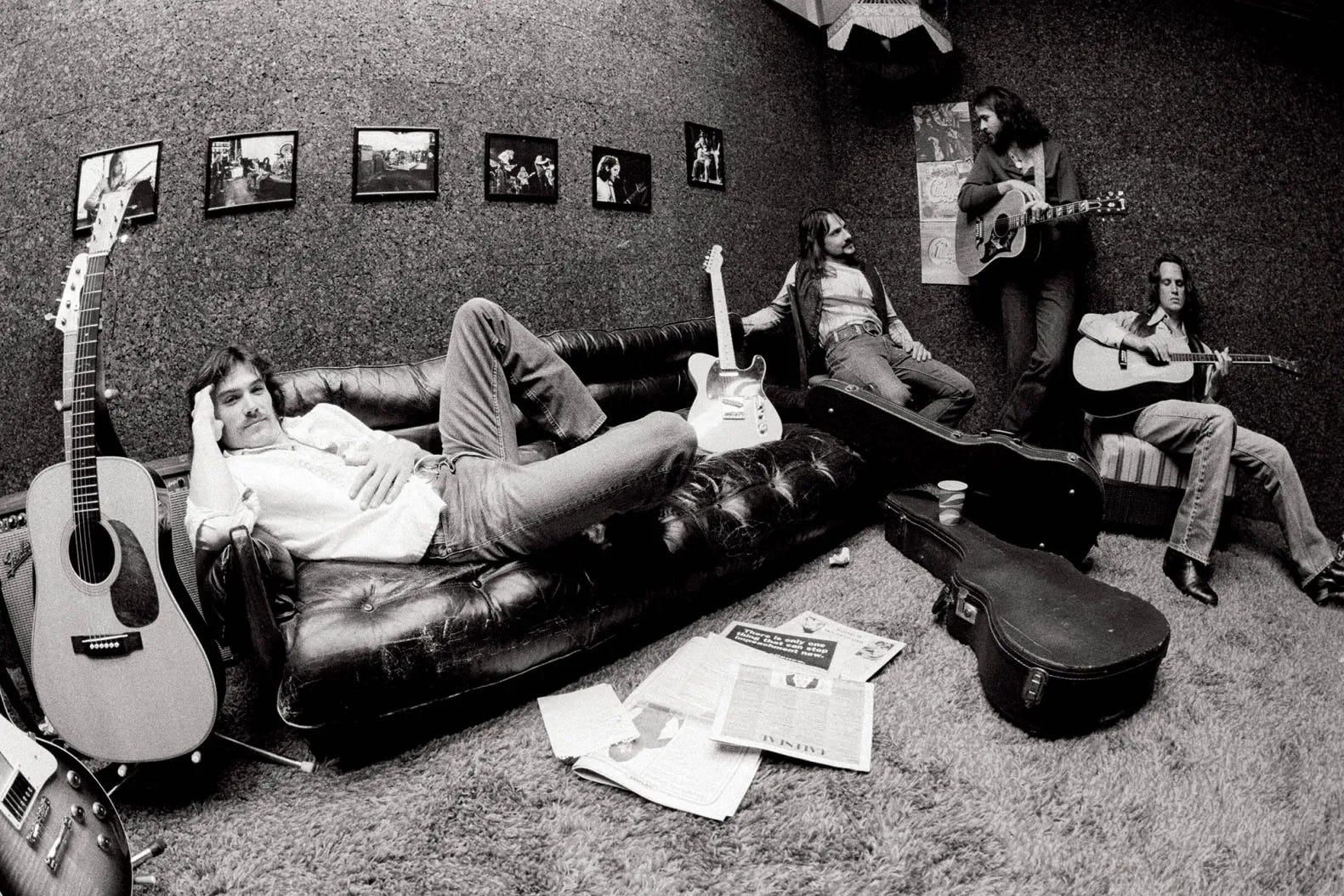
There is also a four-panel poster — Stillwater, arranged in the legendary Allman Brothers Fillmore East pose — and cast photos, and reflections from people who were there, and a Rolling Stone cover, and the cast singing along to Tiny Dancer on a bus that is, depending on your threshold for sentimentality, either the most perfect scene in a movie about rock and roll or proof that Cameron Crowe has always known exactly which emotional buttons to press and has never once hesitated to press them.


One suspects — and I think this suspicion is actually a certainty dressed in modest clothing — that Crowe was doing something more than making a film. He was simultaneously excavating and eulogizing his own biography, the real bands behind the fictional Stillwater: Led Zeppelin, the Allman Brothers, the Eagles. Men who believed, with a conviction that bordered on the genuinely insane, that they were doing something that mattered (I side with the bands in this instance). Crowe, who was there, who was seventeen and carrying a notebook of his own, appears to have never stopped believing they were right.
It is as perfect a document as has ever been released. I don’t say that about things.
Terrific piece on one of my favorite movies. I don't have the box set, and I did not know that the Stillwater / ABB at Fillmore poster was in there. I thought I was the only person in the world that noticed that poster in William's room in the movie. A movie that can toss off a brilliant riff like that, just as an aside that most folks will miss, is a rich work indeed.
One of my all-time favorite movies, and this is a write-up worthy of its subject. Great stuff.